Menu
Menu
-
Summer flowering
- New in 2026
- Anemone
- Begonia
- Caladium
- Canna
- Crocosmia
-
Dahlia
- Dahlia, Anemone-flowered
- Dahlia, Ball
- Dahlia, Cactus and Semi-Cactus
- Dahlia, Dark Angel
- Dalhia, Decorative
- Dahlia, Decorative, water lily
- Dahlia, Single-flowered
- Dahlia, Fimbriata
- Dahlia, Gallery
- Dahlia, Collarette
- Dahlia, Happy Single
- Dahlia, Karma
- Dahlia, Peony-flowered
- Dahlia, Pompon
- Dahlia, Star-shaped, Orchid
- Dahlia, miscellaneous
- Dahlia, BIO
- Gladiolus
- Iris
- Lilium
- Orchids
- Nerine, Amarine
- Oxalis
- Solomon's Seal
- Ranunculus
- Perennials
- Trillium
- Zantedeschia (Calla)
- Other summer flowering bulbs A-L
- Other summerflowering bulbs M-Z
- Gardening, supplies
- Seeds
-
Bulbs for indoors
-
Spring flowering
- Allium
-
Miscellaneous bulbs
- Crocus
- Hyacinths
- Iris
-
Narcissus, daffodils
- Narcissus, trumpet daffodils
- Narcissus, large-cupped daffodils
- Narcissus, small-cupped daffodils
- Narcissus, double daffodils
- Narcissus, triandrus daffodils
- Narcissus, cyclamineus daffodils
- Narcissus, jonquilla daffodils
- Narcissus, tazetta daffodils
- Narcissus, poeticus daffodils
- Narcissus, bulbocodium
- Narcissus, split-corona daffodils
- Narcissus, miscellaneous daffodils
- Narcissus, species, wild variants and wild hybrids daffodils
-
Tulips
- Tulips, Coronet
- Darwin-Hybrid Tulips
- Double-flowering tulips, Peony-flowered tulips
- Tulips, Duc van Tol
- Single Late Tulips
- Single Early Tulips
- Fosteriana-tulips
- Fringed-Tulips
- Greigii-tulips
- Kaufmanniana-tulips
- Lilly-flowered Tulips
- Parrot-Tulips
- Triumph-tulips
- Viridiflora-Tulips
- Multi-flowering-Tulips
- Tulipa, species
- Autumn flowering
- Mixtures & Special offers
-
Categories
-
Summer flowering
-
Gardening, supplies
-
Seeds
-
Bulbs for indoors
-
Spring flowering
-
Autumn flowering
- Mixtures & Special offers
-
Summer flowering
Advantageous priced flower bulbs for the private consumer, go to our other shops.


Announcement
Discover the temporary offer of Galanthus In-the-Green
Tulipa, species
Also called Botanical tulips. These tulips naturalise if planted in a sunny, warm spot. Allow the foliage to die completely after flowering so that nutrients can be absorbed into the bulb. In summer, they need warmth for flower bud development for the following year. Wild tulips can also be planted in the grass, wait until they have completely died off before mowing.
The Woodland Tulip, (Tulipa sylvestris), a native plant, is an exception, it also naturalises in places with less sun
There are 56 products.
Showing 49-56 of 56 item(s)
-
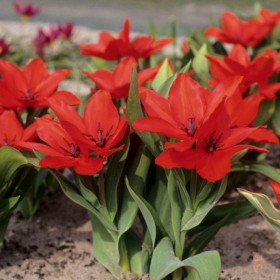
Tulipa praestans 'Zwanenburg Variety'
Scarlet-red, multi-flowering. Height 20-25 cm. -
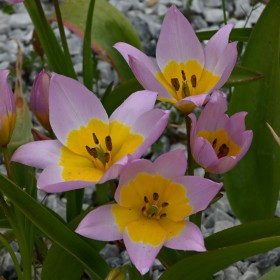
Tulipa saxatilis
Violet pink with a large yellow center. Scented. ‘The Tulip of Candie’. Height 20-30 cm. -
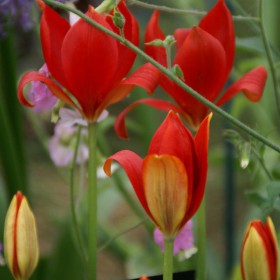
Tulipa sprengeri
This Tulipa species flowers latest of all Tulipa species. Late May, early June. Slender, bright red-orange flower. -
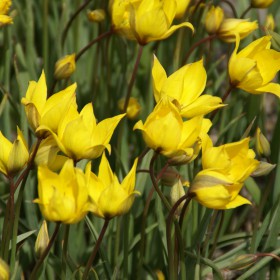
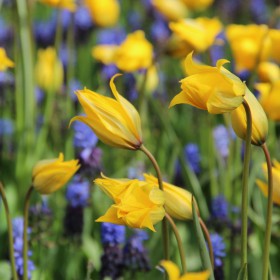
Tulipa sylvestris
Yellow and sweet-scented. Initially nodding flowers. Height 30 cm. Syn. T. florentine odorate. -
Tulipa sylvestris met Muscari latifolium
A fantastic mix of 40 Tulipa sylvestris with 60 Muscari latifolium. Wonderfully scented flowers, perfect for naturalizing. -
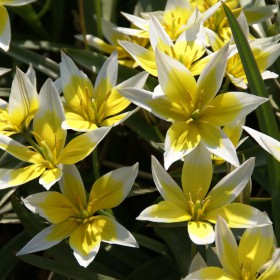
Tulipa tarda
White with a large yellow heart, while the base is brownish purple on the outside. Multi-flowering, suitable for naturalizing and late-flowering. Height 10 cm. -
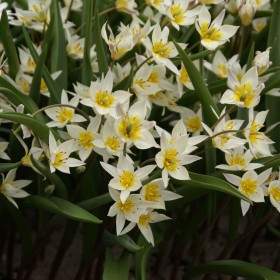
Tulipa turkestanica
Very early, multi-flowered wild tulip. Almost white flowers with a yellow heart. Decorative seed pods appear after flowering. -
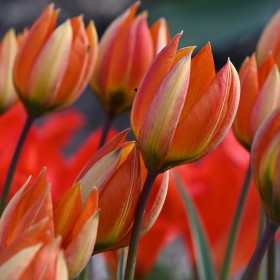
Tulipa whittallii
On the inside bright orange with on the outside a brown shade. Height 25 cm.